Document anonymization solutions: what exists and how to choose
Manual redaction, open-source library, cloud API or on-premise app with local AI: what each document anonymization solution does and how to choose.
In short
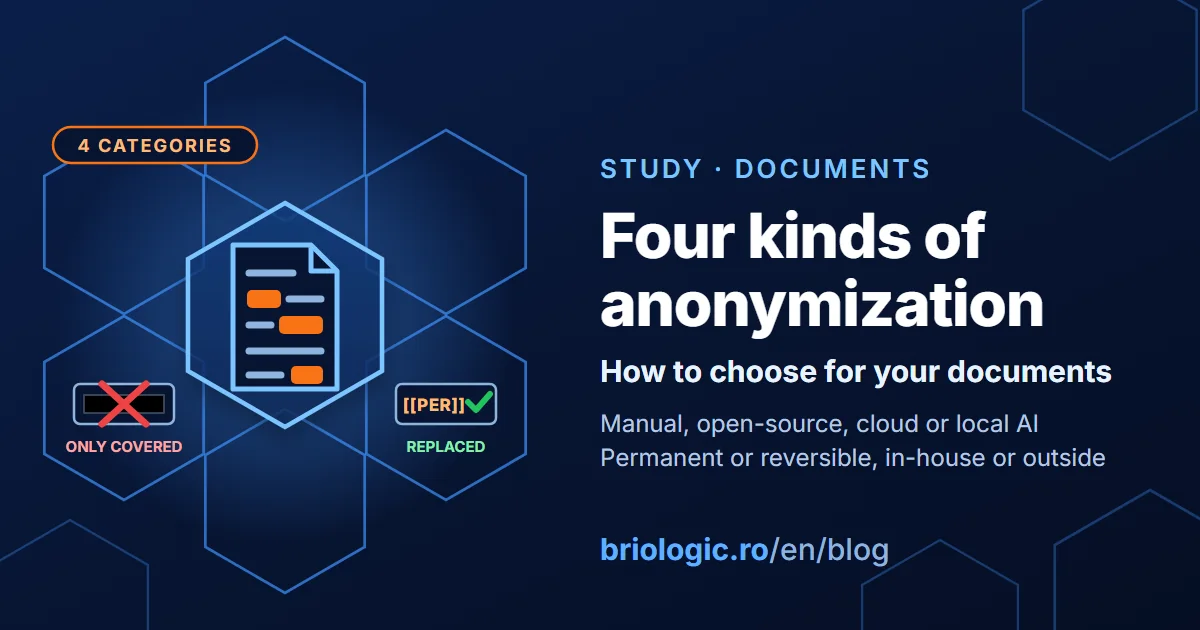
Anonymization solutions fall into four categories: manual redaction (Acrobat Pro, Word's Document Inspector), open-source libraries (Presidio), cloud APIs (Azure AI Language, Amazon Comprehend) and on-premise apps with local AI (Brio Nyx). Two questions decide: must you be able to restore the original, and may the documents leave the company to be anonymized. For Romanian documents, test on your own files whether the solution finds the CNP, CUI and IBAN.
You want to give an AI assistant a contract so it can summarize it. Or you are sending a loan file to a consultant. Or someone asks you for a copy of a document that also mentions other people. In all three situations, the personal data in the document must not leave along with it.
You search for "document anonymization solution" and get a list of names: Adobe Acrobat, Presidio, services from Microsoft and Amazon, a few commercial products. The list is correct, but it mixes tools that solve different problems. One covers the text for good, another is a library for programmers, another sends the document to the cloud to clean it.
Before choosing a product, answer two questions: do you need to be able to restore the original, and are the documents allowed to leave the company to be anonymized. The answers on their own remove most of the names from the list. Below we go through the four categories of solutions one by one, with what each one's documentation says as of November 22, 2026.
Anonymization or pseudonymization: what you are actually looking for
In everyday speech, "anonymization" means any hiding of personal data. The GDPR makes a distinction that changes your obligations.
- Anonymization means the person can no longer be identified by anyone, not even by you. Recital 26 says the regulation doesn't apply to anonymous information. The operation can't be undone.
- Pseudonymization, defined in Article 4(5), means the data can no longer be attributed to a person without additional information, kept separately and protected. Whoever has that information can restore the original.
Replacing names with codes, with a lookup table kept on your side, is pseudonymization. For you, the document still contains personal data. Guidelines 01/2025 of the European Data Protection Board, in the version put out for public consultation, say so explicitly.
For the person receiving the document, things are more nuanced. On September 4, 2025, the Court of Justice of the EU ruled in case C-413/23 P. It held that pseudonymized data is not, in all cases and for every person, personal data. If the recipient has no way to identify the people, the data may not be personal for them. Your obligations toward the data subjects, however, remain the ones that applied before the transfer. The ruling concerns the regulation that applies to EU institutions, which uses the same concepts as the GDPR.
The practical conclusion: pseudonymization greatly reduces the risk, but it doesn't take you out from under the GDPR. Ask each vendor which of the two operations their product performs.
The four categories of solutions
We have not used all the products below in production. For other vendors' products, we report what the official documentation says, with a link.
| Manual redaction | Open-source library | Cloud API | On-premise app with local AI | |
|---|---|---|---|---|
| Examples | Acrobat Pro, Word's Document Inspector | Presidio | Azure AI Language, Amazon Comprehend | Brio Nyx |
| Who finds the data | you | rules and models configured by a programmer | the vendor's service | rules and a local language model, then you check |
| Can you restore the original | no | yes, through encryption with a key | not found in the documentation | yes, with the translation table |
| Where processing happens | on your computer | on your server | in the vendor's cloud | on your server or on a dedicated one |
| Romanian | doesn't depend on language | English by default, others are added | Azure yes, Amazon no | yes, including CNP, CUI and IBAN |
| What you need | time and attention | a development team | a business account and integration | a server with a GPU, or hosting |
In the table and below, CNP is the Romanian personal identification number and CUI is the Romanian company tax ID.
Manual redaction. In Acrobat Pro you mark the text or image, apply, and the content is removed from the file. Adobe also recommends the Sanitize step, which removes metadata, attached files, hidden layers and comments. Both features exist only in Acrobat Pro. In Word, Document Inspector removes comments, tracked changes, document properties, headers and text formatted as hidden. It doesn't look for names or ID numbers in the text: you find those yourself. It is the right option for a few documents a month, handed over for good.
Open-source library. Presidio, created at Microsoft and now developed by the community, is the best-known example. The documentation describes it as a library or SDK, not a service: it is installed as a Python package or as an API in Docker, and a programmer adapts it. It works on text and on images, and the default configuration is for English. It has built-in recognition for identifiers from 18 countries, and Romania is not among them. The CNP, the CUI and Romanian names require rules and a language model that you add. The values found can be replaced, masked or encrypted, and encryption is reversed with the same key. In the pages we read, we found no processing of Word or Excel files that preserves formatting. The authors warn that automatic detection doesn't guarantee finding all the data. It suits companies with a development team that integrate anonymization into their own workflow.
Cloud API. You send the text and get back the entities found. Azure AI Language has Romanian in its list of languages, both for text and for PDF, DOCX and TXT files. Amazon Comprehend detects personal data only in English and Spanish. We have not measured how well Azure recognizes Romanian identifiers, and the language list doesn't say. The underlying problem is a different one: to remove the personal data from the document, you send a third party the whole document, with the data in it. It can be done legally, with a business account and a processing agreement. It can't be done when your clauses with clients forbid any third party.
On-premise app with local AI. Detection runs on a server inside your perimeter, with a local language model, so the document doesn't go anywhere to be cleaned. This is where Brio Nyx, our application, fits. Identifiers with a fixed format (CNP, CUI, IBAN, card) are found with rules and verified by their check digit. Names, companies and addresses are found by a local model, through Ollama. Each value becomes a token of the form [[PER_3f2a9c1e]], the same across all the documents in a project. The document comes out in the format it went in: Word, Excel, PowerPoint, PDF or email. There are other applications of this kind, built for other languages; we describe the one we know from the inside.
Where data slips through, whatever the solution
Four places to check every time, because that is where data stays behind most easily:
- The black rectangle drawn over the text. The text stays in the file. A simple check: select all the content of the page, copy it and paste it into Notepad.
- The areas you don't see. The author in the file properties, comments, tracked changes, headers and the attachments of an email. Microsoft notes that Document Inspector doesn't detect text hidden in other ways, for example white on a white background.
- Variants of the same name. "Popescu Ion", "Ion Popescu" and "Mr. Popescu" are the same person, and so are "SC Alfa SRL" and "ALFA S.R.L.". A single variant left behind cancels the rest of the work.
- Context. "The director of the only hospital in town" identifies the person even without a name. No automatic tool fully solves this, so a person has the last word.
How to choose: five questions, in order
- Do you need to be able to restore the original? If the document is published or handed over for good, you need irreversible redaction. If an AI's or a consultant's answer has to be linked back to the real people, you need pseudonymization with a lookup table.
- Are the documents allowed to leave the company to be anonymized? Read the confidentiality clauses signed with your clients. If they forbid any third party, the local options remain: manual, your own library or an on-premise application.
- How many documents, and in what formats? A few PDFs a month can be done by hand. Hundreds of Word and Excel files and emails require automatic detection and preserving the format.
- Does it find Romanian identifiers? Don't rely on the brochure. Take ten real documents, run them through the solution and count what is left: CNP, CUI, IBAN, names, addresses. Look in the header, in the comments and in the file properties too.
- Who checks, and what proof remains? Ask for a human review step before download. Ask also for a log that shows who downloaded the document and who saw the real values.
If you are only now setting the rules for AI at your company, start with where the documents you upload to ChatGPT, Claude or Gemini end up. Anonymization comes after choosing the account, not instead of it.
Where it doesn't fit
The limits of Brio Nyx, stated plainly:
- It doesn't read scanned documents. It works on text and has no OCR. For scanned pages you need another tool.
- It doesn't do irreversible anonymization. Tokens can be restored by anyone with rights on the project. A document that is going to be published needs permanent redaction.
- It needs a server with a GPU, your own or a dedicated one managed by us. For three contracts a year it isn't worth it: manual redaction is enough.
- The accuracy figures are indicative. On our internal corpus of 12 documents, the default model found all the personal data, with an F1 score of 96.4%. The corpus is small, which is why every document can be reviewed by a person before download.
- It doesn't hide context. Tokens replace names and identifiers, not the descriptions from which the person can be guessed.
How we do it
We split documents into two groups: those that go out and come back, and those that go out for good.
For the first group we use Brio Nyx. The document is uploaded into a project, detection proposes what needs to be replaced, a person accepts or rejects directly on the text, then the tokenized version is downloaded. That version goes to the AI service or to the consultant. The answer that comes back, with the tokens in it, is restored with the translation table, which stays encrypted on the server.
For the second group we use the redaction in Brio DocForge: you drag a rectangle over what needs to disappear, and the content is removed from the PDF, not covered. DocForge also has Romanian OCR, so it works on scanned documents too.
If you don't know which category your documents fall into, write to us with what kind of documents they are, how many a month and who you send them to. We'll tell you in a few minutes whether you need permanent redaction, reversible tokens or just Word's Document Inspector.
Frequently asked questions
What is the difference between anonymization and pseudonymization?
Anonymization is irreversible: nobody can link the data to a person anymore, and the GDPR no longer applies to that information. Pseudonymization replaces the data with codes and keeps the key for restoring it separately. For whoever has the key, the document still contains personal data, so the GDPR obligations remain.
Is it enough to cover the text with a black rectangle in a PDF?
No. A rectangle drawn over the text only hides it visually, and the text stays in the file and can be selected and copied. You need a redaction feature that removes the content, such as Redact in Acrobat Pro. You check the result by copying all the text on the page into a plain editor.
Can I anonymize a document without buying anything?
Yes, for small volumes. Document Inspector is included in Word and removes comments, tracked changes and file properties, and you replace the names in the text yourself. Presidio is open-source, but it needs a programmer to install it and add rules for Romanian. The real cost is the time and the risk of a forgotten name.
Which anonymization solution recognizes the CNP and the CUI?
Presidio has no built-in recognition for Romanian identifiers, so the rules have to be written. Azure AI Language has Romanian in its list of languages, but we have not measured how it handles Romanian identifiers. Brio Nyx verifies the CNP, the CUI and the IBAN by their check digit. Whatever the solution, test it on ten of your own documents before relying on it.
Can I send an anonymized document to ChatGPT?
A document in which names and identifiers have been replaced with tokens exposes much less than the original. The context remains, from which a person can sometimes be guessed, and so do your obligations as data controller. Use a business account, with a processing agreement, and read the document once more before sending it.


