BrioLogic application
Brio Nyx Reversible document anonymization, with local AI
Sensitive data stays with you. The document goes out clean and comes back whole.
Brio Nyx is a web application that finds personal and confidential data in documents, replaces it with tokens such as [[PER_3f2a9c1e]] and can restore the original at any time. The anonymized document comes out in the same format and with the same layout: Word stays Word, Excel stays Excel, PDF stays PDF. You can safely send it to an AI service, a consultant or a partner, and the reply you get back, tokens included, is restored automatically.
The name comes from Nyx, the primordial goddess of the night in Greek mythology, associated with what stays hidden. Everything sensitive stays covered while the document is outside your company, and everything runs inside the same perimeter: the application, the database and the AI models, through Ollama, with no calls to any cloud service.
At a glance
- Use AI without the risk. You send ChatGPT, Claude or any other service only tokenized documents, and the reply is restored automatically.
- Minutes, not hours. Automatic detection replaces searching through the contract by hand; a person only checks the result.
- Nothing slips through. Headers, footers, comments, tracked changes, metadata and attachments are all handled, and the final document is checked once more for the original values.
- Reversible and consistent. The same person gets the same token in every document of a project; the original can be restored at any time.
- Your data stays with you. The application, the database and the AI models run inside your perimeter, encrypted, with a full audit log.
- Adaptable. Data types, rules, terms and AI instructions can be configured per organization and per project.
Who it's for
For organizations that want to use generative AI, outside consultants or partners on real documents without exposing personal data or professional secrets:
- Law firms and legal departments. Contracts, statements of claim and court judgments sent to an AI for a summary or analysis; the reply comes back with the parties' names restored.
- Banks, non-bank lenders and insurers. Credit or claim files given to an outside consultant or analytics provider, without CNPs (Romanian personal numeric codes) and IBANs.
- Hospitals and clinics. Medical records and letters used in research or staff training, without the patients' identities.
- HR departments. CVs and personnel files reviewed without identifying data, for unbiased recruitment.
- Public institutions. Documents published or released on request under Law 544/2001 on free access to public information, with the data of private individuals hidden.
- IT and development teams. Real test data (CSV and JSON exports, emails) pseudonymized before it reaches outside teams.
- Audit and consulting. Large sets of documents exchanged with auditors without exposing end clients' data.
The problem it solves
Organizations want to use generative AI and outside consultants on real documents, but those documents contain personal data that the GDPR and professional secrecy do not allow to leave the company.
- Manual anonymization is slow and unreliable. A 20-page contract takes dozens of minutes of search and replace, and a single name forgotten in a header, a comment or the file's metadata is enough for a data leak.
- Replacing data with "XXX" is irreversible. Once the document has been processed by an AI or a consultant, the result can no longer be linked back to the real people.
- Cloud tools move the problem instead of solving it. To anonymize, they send the sensitive data itself to a third-party server.
- Hidden data is the easiest to miss: the author in the document properties, tracked changes, comments, footnotes, text in a PDF that is only visually covered by a black rectangle.
Brio Nyx solves all four: automatic detection checked by a person, reversible tokens, fully local processing and handling of every hidden area of the file.
How it works
Only the tokenized document leaves the perimeter. The key to restore it stays with you, in the encrypted translation table.
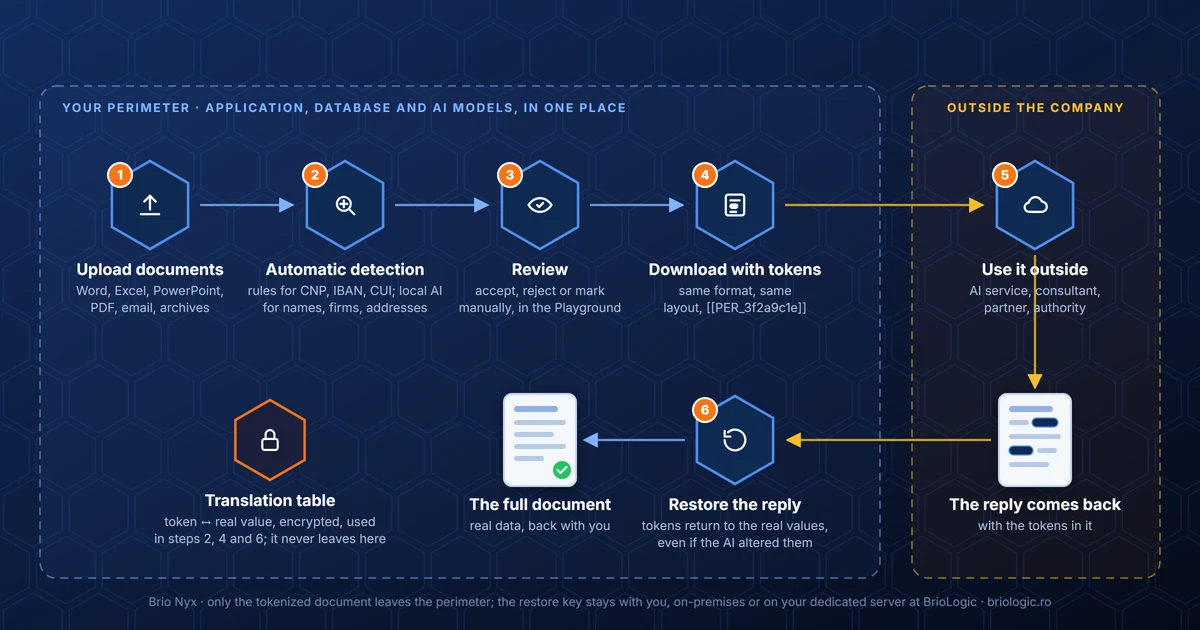
- You upload the documents to the Content Manager or straight into a project: individual files, drag & drop, or ZIP and 7z archives.
- The application detects the sensitive data: rules find the identifiers (CNP, IBAN, CUI, the Romanian company tax ID), and the local AI model finds names, companies and addresses.
- You review in the Playground: accept, reject or mark items by hand, directly on the text. For large batches, the changes can be applied automatically.
- You download the anonymized document, in the same format and with the same layout. Each entity has a unique token within the project.
- You use it outside the company: send it to an AI service, a consultant or a partner.
- You restore the reply: upload the file you received or paste the text, and the tokens turn back into the real values.
The same paragraph, before and after
The sample data is fictitious (a Romanian power of attorney). "Alfa Bank SA" and "SC Beta Consult SRL" get different tokens, but "Beta Consult", "BETA CONSULT S.R.L." and "Beta Consult SRL" in other documents of the project get the same token.
What data it detects
Detection is hybrid. Identifiers with a fixed format are found by rules and verified mathematically wherever there is a check digit: a number that merely looks like a CNP is not replaced. Data without a fixed format (names, companies, addresses, dates of birth) is found by a language model that understands context: a date of birth is anonymized, an invoice date is not.
| Data type | Token | How it is detected |
|---|---|---|
| Person | PER | AI, from context |
| Organization | ORG | AI, from context |
| Address | ADR | AI, from context |
| Date of birth | DOB | AI, only when the context shows it |
| CNP (Romanian personal numeric code) | CNP | rule, check digit, date and county code |
| CUI / CIF (Romanian company tax ID) | CUI | rule and check digit |
| IBAN | IBN | rule and the mod 97 algorithm |
| Bank card | CRD | rule and the Luhn algorithm (optional) |
| Trade Register number | NRC | rule, old and new format |
EML | rule | |
| Phone | TEL | rule, Romanian mobile and landline |
| ID card series and number | CI | rule |
| Vehicle registration number | AUT | rule, all counties |
- Hallucination protection: any entity proposed by the AI that does not appear verbatim in the text is removed automatically.
- Titles are ignored (Romanian "dl.", "dr.", "av.", that is Mr., Dr., attorney), so the same person gets the same token wherever they appear.
- Variants of a company name are merged: "SC Alfa SRL", "ALFA S.R.L." and "Alfa" get the same token.
- New types, custom rules. Administrators add data types with their own rules and can edit the instructions given to the AI model, with version history.
Supported formats, with the layout preserved
- Word, Excel, PowerPoint (docx, xlsx, pptx): text, tables, headers and footers, notes, comments, tracked changes, field codes, metadata (author, company), links.
- PDF: true redaction, the old text is removed from the file, not just covered. Style of your choice: inline, or the classic black box with the token in white.
- Legacy and open formats: doc, xls, ppt, rtf, odt, ods, odp.
- Email (EML): sender, recipients, subject, plain-text and HTML body, plus attachments, processed recursively.
- Text: txt, csv, md, json, xml, html, with the original encoding preserved.
- ZIP and 7z archives, including password-protected ones: imported in one go, each archive becomes a project.
Review, projects and restoration
Human review in the Playground
- Each detected entity is highlighted on the text, with its exact location in the document: header, cell B2, page 1, attachment.
- You accept or reject, change the type, select any fragment and mark it by hand, for all its occurrences.
- Variants of the same person ("Popescu Ion" and "Ion Popescu") are merged under a single token.
- Preview with the original layout and side-by-side comparison between versions, with differences highlighted word by word.
- A decision can be raised to project level: "Never anonymize" or "Always anonymize".
Projects and the translation table
- The same person gets the same token in every document of the project, so the relationships between documents are preserved.
- Custom terms: an "always anonymize" list (project names, internal codes) and a "never anonymize" list (your own company's name, public institutions).
- Real values are shown masked ("I•• P••••••"); revealing them requires edit rights and is recorded in the audit log.
- Project members with roles (editor, viewer); a viewer can download only the anonymized versions.
Restoration (de-anonymization)
- Works on any document that contains the project's tokens, including a new one received back from an external AI or a consultant.
- Also recognizes tokens altered by the AI (lost brackets, changed capitalization) and reports unknown tokens.
- Works on a file or on pasted text, with the result ready to copy.
Productivity and administration
- Bulk anonymization, on a selection or on a whole project, with automatic application or document-by-document review ("Next to review").
- Background processing, with live progress and notifications on completion; ZIP export of a project or a selection, optionally encrypted with AES-256.
- Recognizes documents that are already anonymized when they are uploaded again and does not anonymize them a second time.
- Dashboard with projects, documents, jobs in progress and entities by type; monitoring of the AI servers: requests, errors, latency, tokens consumed, by model, server and user.
- Multiple Ollama servers on the network, with load balancing and automatic failover to another server when one goes down.
- Users with roles (administrator, user, auditor), full audit log, interface in Romanian and English, light and dark theme.
Security, privacy and the GDPR
No data leaves your perimeter: the application, the database and the AI models run on the same server or on the same network, and everything sensitive is stored encrypted.
| Processing | entirely inside your perimeter; the AI models run locally through Ollama, with no calls to cloud services |
|---|---|
| Files | encrypted with AES-256-GCM on disk; on deletion they are overwritten before removal |
| Translation table | original values encrypted; lookups use an HMAC fingerprint, not plain text |
| Encryption keys | key rotation without data loss; the application refuses to start with a wrong key |
| Authentication | argon2 passwords, complexity policy, short sessions with secure renewal |
| Authentication attacks | lockout per account and IP address, increasing delay, alert on distributed attacks |
| Access | global and per-project roles; a project you have no access to does not even appear |
| Audit | every download, real-value reveal and administrative change is logged; encrypted audit archives |
| Network | access over HTTPS only, security headers (CSP, HSTS), dedicated SQL account with minimal rights |
| Continuity | backup and restore verified with checksums; configurable retention for documents and logs |
| Final check | after anonymization, the resulting document is scanned again for the original values; anything left over is reported |
Technically, reversible tokenization is pseudonymization within the meaning of Article 4(5) GDPR, not irreversible anonymization, because you hold the key to restore the data. That is exactly the product's advantage. Brio Nyx supports the principles of data minimization, pseudonymization and security of processing; compliance depends on how you use it, and we help you with the processing documentation.
Where it runs
On your servers (on-premises)
Brio Nyx ships as a set of Docker Compose containers and is installed in your infrastructure, with no external dependencies and no internet access needed while it runs. From the outside, only the proxy's HTTPS port is visible. For AI detection you need one or more GPU servers running Ollama; the application spreads requests across them and automatically routes around any that are down.
Hosted by BrioLogic
If you don't have a GPU server or don't want to manage the infrastructure, we provide a dedicated server, managed by us, in Romania: the application, the database and the AI models run together on it, and we take care of installation, updates, backup and monitoring. Even in this option, your documents never reach any cloud AI provider.
Either way, initial setup, team training and support are part of the BrioLogic service.
Technologies
| Interface | React, TypeScript, Mantine, Vite; bilingual, light and dark theme |
|---|---|
| API | Python, FastAPI, SQLAlchemy: authentication, permissions, projects, documents, audit |
| Worker | Python, PyMuPDF, lxml, headless LibreOffice: detection, anonymization, restoration and conversions, in the background |
| Database | Microsoft SQL Server 2022: metadata, the job queue, the encrypted translation table |
| AI | Ollama with open-weight models (Qwen3 30B by default), for names, companies and addresses; the model and the instructions are chosen in the interface, per organization and per project |
| Proxy | Caddy: HTTPS with an internal or your own certificate, security headers |
| Operations | backup and restore scripts that verify integrity and the encryption key; more than 190 automated tests and an evaluation suite for detection accuracy |
Brio Nyx and Brio DocForge
Brio DocForge also has an anonymization feature, but the two products solve different problems and complement each other.
| Brio DocForge | Brio Nyx | |
|---|---|---|
| What it does | manual redaction: you draw rectangles over whatever has to disappear | automatic detection of personal data, with rules and local AI |
| Result | permanent: the content is removed from the file | reversible: tokens that can be restored at any time |
| Formats | Word, Excel, PowerPoint, PDF, email, text, archives | |
| Best for | documents that must be published or handed over without the covered data, for good | documents that go to an AI, a consultant or a partner, and whose reply has to be linked back to the real people |
| Scanned documents | yes, with OCR in Romanian and English | not in the current version |
What it doesn't do
- It does not process scanned documents. Brio Nyx works on text; OCR is not included. For scanned pages, use Brio DocForge or Brio Argus.
- It does not do irreversible anonymization. Tokens can be restored by anyone with rights on the project. For permanent redaction in PDF, use DocForge.
- It does not use cloud AI models. This is a design choice: detection runs only on Ollama, locally, which means you need a GPU server, your own or one managed by BrioLogic.
- It does not replace human review. Automatic detection, hallucination protection and the final check greatly reduce the risk, but review in the Playground remains the step that gives you certainty, especially for the first documents in a project.
- It does not yet authenticate through LDAP or Active Directory. Accounts are managed in the application; integration with the company directory is planned.
Frequently asked questions
Does my data end up on the internet?
No. The application, the database and the AI models run inside the same perimeter: on your servers or on a dedicated server managed by BrioLogic. There are no calls to cloud services. Only the tokenized document goes out, and only when you send it.
Can I get the original document back?
Yes. The mapping between tokens and real values is stored encrypted, per project, and any document that contains the project's tokens can be restored, even one rewritten by an AI or a consultant.
Is this anonymization or pseudonymization under the GDPR?
Technically, reversible tokenization is pseudonymization within the meaning of Article 4(5) GDPR, because you hold the key to restore the data. That is exactly the product's advantage: the document that goes out contains no personal data, and you remain the only one who can put it back. Brio Nyx supports the principles of data minimization, pseudonymization and security of processing; compliance depends on how you use it.
How accurate is the detection?
On our internal test corpus of 12 documents, the default model found all the personal data (recall 100%, F1 96.4%). The corpus is small, so we treat these figures as indicative. That is why every document can be reviewed by a person in the Playground before the changes are applied, and the resulting document is scanned again for the original values.
Which formats does it accept?
Word, Excel and PowerPoint, PDF, legacy Office formats (doc, xls, ppt), RTF, OpenDocument (odt, ods, odp), EML email with attachments, text files (txt, csv, md, json, xml, html) and ZIP or 7z archives, including password-protected ones.
Does it work on scanned documents?
Not in the current version. Brio Nyx works on text, and scanned documents require OCR, which is not included. If you need OCR, Brio DocForge and Brio Argus offer it.
Can I add my own data types?
Yes. Administrators define new types with their own rules and can edit the instructions given to the AI model, with version history. In each project you can add terms that are always or never anonymized.
What hardware is required?
A Linux server with Docker for the application and the database and, for AI detection, a GPU server running Ollama. Sizing depends on your document volume. If you don't have a GPU server, we provide a dedicated one, managed by BrioLogic.
Is the interface in Romanian?
Yes, in Romanian and in English, switchable with one click, in a light or dark theme.
See Brio Nyx on your own documents
A demo takes 30 minutes, on documents from your own work, with fictitious or real data, inside your perimeter.